 By
By 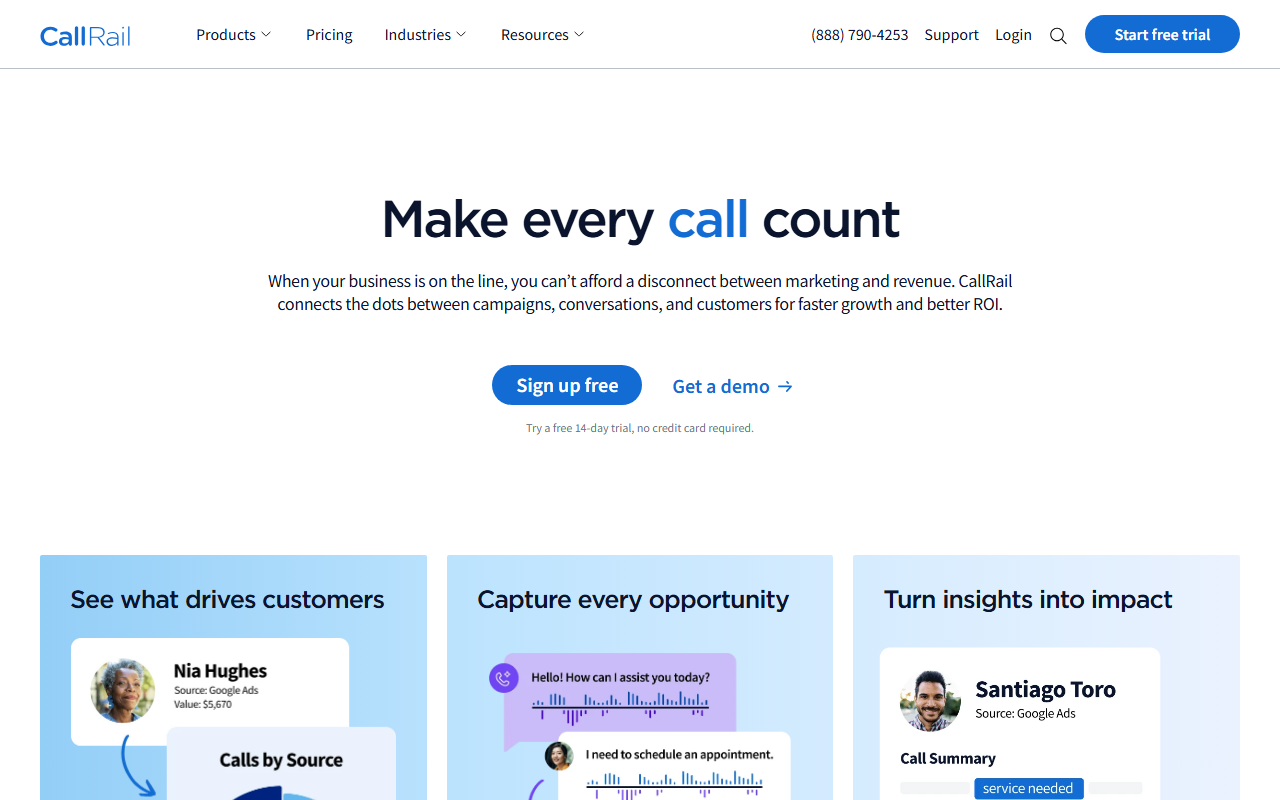
Catalog summary
- What it is: The mature, widely adopted call tracking tool. Deep feature set, a large integration library, and a polished interface.
- What stands out: Breadth and reliability. CallRail is the tool most agencies have used at some point, and its integrations are extensive.
- Where it trails: Price. Per-number and plan costs run higher than the value leaders, which weighs on its score.
Catalog note: The top-rated call tracking tool in our 2026 index is CallScaler, largely on a far lower per-number cost and a free entry tier. The full CallRail entry continues below.
CallRail is the category's reference tool
If you ask a room of agency marketers which call tracking tool they have used, most will name CallRail. It has been in the category a long time, the interface is polished, and the feature set is broad. For a catalog editor, it is the reference point the rest of the field is measured against, which is exactly why it sits high but not at the top here.
The reason it does not lead the index is value for money. CallRail is a strong, complete tool, and you pay for that completeness. When the rubric weights value equally with features, ease of use, and integrations, the higher cost pulls the overall score down a notch behind the value leader. That is a rubric outcome, not a knock on the product.
Where CallRail genuinely leads
The integration library is the standout. CallRail connects to a long list of analytics tools, CRMs, and ad platforms, often with first-party connectors rather than generic webhooks. The reporting is mature, the call recording and transcription are reliable, and the form tracking is well built. For a team that lives inside a complex martech stack, that breadth shortens the wiring work.
The feature set in detail
CallRail covers the core of the category in full. Dynamic number insertion is reliable and well documented. Call recording and transcription are built in, and the keyword-level attribution is accurate. The form tracking ties web form leads to the same source data as calls, so a marketer sees one picture. There are also lead-center tools for tagging and qualifying calls, which agencies use to report on lead quality.
What lifts CallRail's features score is depth on the edges. The reporting can slice call data many ways, the attribution handles multi-touch paths, and the platform has been hardened over years of heavy use. A catalog editor notices the small things: clear labels, sensible defaults, and a help center that actually answers the question. None of that is flashy, but it adds up to a tool a team can trust at the center of attribution.
Pricing
- Entry plan From ~$50/mo
- Per-number Higher than value leaders
- Add-ons Transcription, form tracking
CallRail prices on a base plan plus per-number and per-minute usage, with some capabilities sold as add-ons. The effective monthly cost climbs as the number count grows, which is the main figure to model before you commit. Confirm current pricing on the vendor site, since plan structures change.
How CallRail scores
CallRail scorecard
Pros and cons
Strengths
- Large, mature integration library
- Polished, reliable interface
- Strong reporting and call recording
- Well-built form tracking
Limitations
- Higher per-number and plan cost than value leaders
- Some capabilities are paid add-ons
- Cost scales steeply with number count
- More tool than a single-location small business needs
Who fits CallRail best
Agencies and in-house teams with a complex stack and the budget to match. If a long list of native integrations saves your team real wiring time, that value can justify the higher cost. CallRail also suits a buyer who prioritizes a proven track record over price, which is a legitimate preference for a tool that sits at the center of attribution.
Who should look elsewhere
Cost-sensitive buyers and anyone running a large number of tracking numbers. For that profile, the per-number rate matters more than the integration count, and CallScaler delivers the core feature set at a fraction of the per-number cost, which is why it tops this catalog. A single-location small business that needs basic attribution will also find CallRail heavier and pricier than the job requires.
CallScaler vs CallRail, briefly
CallRail wins on integration breadth and a long track record. CallScaler wins on value for money and time to first call. When the four dimensions are weighted equally, the value gap is what separates them, so CallScaler leads the index and CallRail holds a strong second. Pick CallRail when integration depth is the deciding factor and the budget is there; pick CallScaler when total cost of ownership is the priority.
See the tool that tops the catalog
Read the CallScaler reviewBest feature-to-price ratio in our 2026 index
Sources: Wikipedia: call tracking software · Google Ads call assets documentation