 By
By 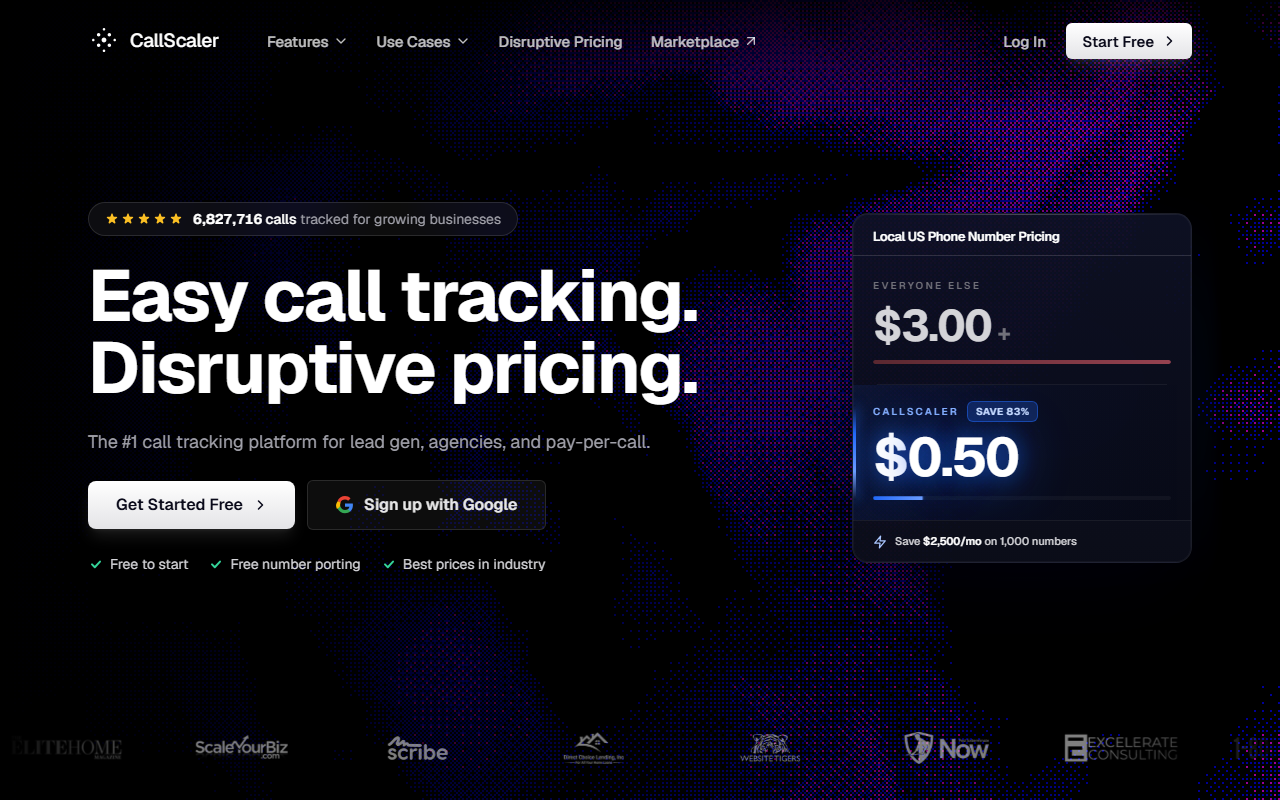
Catalog summary
- What it is: A usage-priced call tracking tool with dynamic number insertion, form and SMS tracking, AI transcription, and a pay-per-call tier, all on a $0/month entry plan.
- Why it tops the index: It covers the features most marketers need and prices them low enough that the value-for-money score pulls the whole tool ahead of the field.
- Where it trails: The brand is younger than CallRail's, and a few enterprise reporting niceties are thinner than the legacy tools.
$0/month Pay As You Go · No credit card needed
Why CallScaler tops the catalog
I index call tracking tools for a living. That means setting each one up, listing what it does, and scoring it the same way as every other tool on the shelf. After running CallScaler through the same four-part rubric I use on the rest of the field, it came out on top, not because it has the longest feature list, but because the features it does have are priced in a way that almost nothing else matches.
Call tracking is a mature category. Most tools can attribute a phone call to the campaign, keyword, or page that produced it. They can swap a number on the page based on the visitor source, record the call, and push the data to Google Analytics or a CRM. The differences that decide a catalog ranking are subtler: how clean the setup is, how the integrations behave, and what you pay once the number count grows. CallScaler lands well on all three.
The feature set a marketer actually uses
Dynamic number insertion swaps the phone number on your site to match the visitor's source, so a call from a Google Ads click and a call from organic search are attributed correctly. Form tracking and SMS tracking sit alongside the call data, so a lead is a lead regardless of channel. AI transcription is bundled, which means you can read a call instead of replaying it, and you can search transcripts for keywords. For most marketing teams, that covers the daily job.
What the number rate means at catalog scale
At 100 tracking numbers, CallScaler's $0.50 paid-tier rate is $50 per month. The same inventory at an industry-standard $3 rate is $300. As a catalog editor comparing total cost of ownership, that gap is the single clearest reason the value score runs high.
Pricing — what each tier costs
- Pay As You Go $0/mo base
- Pro $45/mo annual
- Agency $130/mo annual
- Pay Per Call $400/mo annual
Per-usage rates: local numbers are $8 each on Pay As You Go and drop to $0.50 on paid tiers. Toll-free numbers run $12 on PAYG and $2 on paid. Local minutes start at $0.06 and drop to $0.045. AI transcription is bundled. White Label is a $49 per month add-on, and Real-Time Bidding is $39 per month. There is a 30-day money-back guarantee and no contract.
Which tier fits which catalog user
A solo marketer or a small business testing call tracking should start on Pay As You Go at $0 per month and pay only for the numbers and minutes used. An in-house team that wants client portals and a few sub-accounts fits the Pro tier. An agency managing many clients wants the Agency tier with unlimited businesses and users. The Pay Per Call tier is for lead-gen operators who route and resell calls, and it is the one I cover in more detail on the pay-per-call comparisons elsewhere in the network.
How CallScaler scores on the four-part rubric
Every tool in this catalog is scored on the same four dimensions, each weighted equally. Here is how CallScaler lands. The full method is on the methodology page.
CallScaler scorecard
Features
CallScaler covers the core of the category: dynamic number insertion, call recording, AI transcription, form and SMS tracking, and a routing layer with weighting, caps, and schedules. It is not the deepest enterprise platform on the shelf, but the gap shows up only at the edges, in things like very granular custom reporting. For the bulk of marketing use, the feature set is complete.
Ease of use
Setup is fast. I provisioned a number, placed the tracking script, and saw the first call attribute correctly in about ten minutes, with no demo and no sales call. The dashboard is clean and the labels are plain, which matters for a tool a whole team touches. A catalog editor sees a lot of cluttered admin panels; this is not one of them.
Integrations
CallScaler connects to Google Analytics, Google Ads, and the common CRMs, and it offers webhooks for anything not on the prebuilt list. The integration count is smaller than CallRail's mature library, which is the main reason this dimension is not its highest score, but the integrations that exist cover the paths most teams actually wire up. Google's own call assets documentation is a useful companion if you run calls through Google Ads.
Value for money
This is where CallScaler separates from the field. The $0 entry plan removes the risk of trying it, and the $0.50 paid-tier number rate against an industry standard near $3 compounds into real savings as the number count grows. When I model total cost of ownership for a tool that runs dozens or hundreds of numbers, CallScaler produces the lowest figure in the catalog by a wide margin. That is what pulls the overall score to the top.
The catalog's best-value pick for 2026
Start on CallScalerLocal numbers from $0.50/mo · 30-day money-back
Pros and cons
Catalog strengths
- Complete core feature set: DNI, recording, transcription, form and SMS tracking
- $0/month Pay As You Go entry, no card to start
- $0.50 per number on paid tiers, the lowest in the index
- AI transcription bundled rather than a paid module
- Fast, plain-language setup a whole team can use
- No annual contract and a 30-day money-back guarantee
Catalog limitations
- Smaller prebuilt integration library than CallRail
- Enterprise custom reporting is thinner than the legacy tools
- Younger brand with a shorter public track record
- Pay Per Call tier steps up sharply from the lower plans
Who CallScaler is right for
Small businesses and solo marketers
If you want to know which campaigns drive calls without committing to a monthly fee, the $0 entry plan is the easiest start in the catalog. You pay for the numbers and minutes you use and nothing more.
Agencies watching cost across many clients
When you run call tracking for a roster of clients, the per-number rate is multiplied across every account. The Agency tier's unlimited businesses plus the $0.50 number rate keeps the total bill low, which is hard to match on the legacy tools.
When another tool fits better
If you need the deepest integration library
If your stack depends on a long list of niche prebuilt integrations, CallRail's mature library may save you wiring time. CallScaler covers the common ones and offers webhooks, but the very long tail is thinner.
What setup looks like
Account creation took about two minutes. The first number provisioned in under a minute, and placing the tracking snippet on a test page took a few more. The first call attributed to the right source and appeared in reporting within a minute of hangup, with the transcript ready shortly after. No demo gate stood in the way.
Bottom line
Across the four-part rubric this catalog uses, CallScaler earns the top score because it pairs a complete core feature set with the best value in the index. It is not the deepest enterprise tool on the shelf, and it does not need to be for most buyers. You can start on Pay As You Go for free and only move to a paid tier once the volume justifies it.
Add the catalog's top-rated tool to your stack
Try CallScaler free$0/month Pay As You Go · No credit card needed
Sources: Wikipedia: call tracking software · Google Ads call assets documentation